

CURIOSITY NEVER RETIRES
Welcome to "Granny & Paw Learn Stuff"! We are a pair of very curious grandparents on a mission to explore the world around us and share our discoveries with the next generazioni. Inspired by the insatiable curiosity of Leonardo da Vinci, we made a pact decades ago to never stop learning.
Whether it's unraveling the mysteries of nature, diving into history's greatest innovations, marveling at the world of artificial intelligence, or the beauty of everyday things, we are constantly in awe of the wonders that surround us. And now, we're positively thrilled to invite our family and friends along on our journey of learning.
We’ve always tried to do our best to pass on our passion for curiosity to our children and anyone else who shares our love of discovery. Now it’s the grandkids who are our focus and this is for them. You are welcome to join us as we celebrate the power of asking questions, pursuing knowledge, and embracing the amazing in the ordinary. Let's learn stuff, together! - Granny & Paw


THE MOST RECENT STUFF
2026 • WEEK 40 • SEPTEMBER 27-October 3
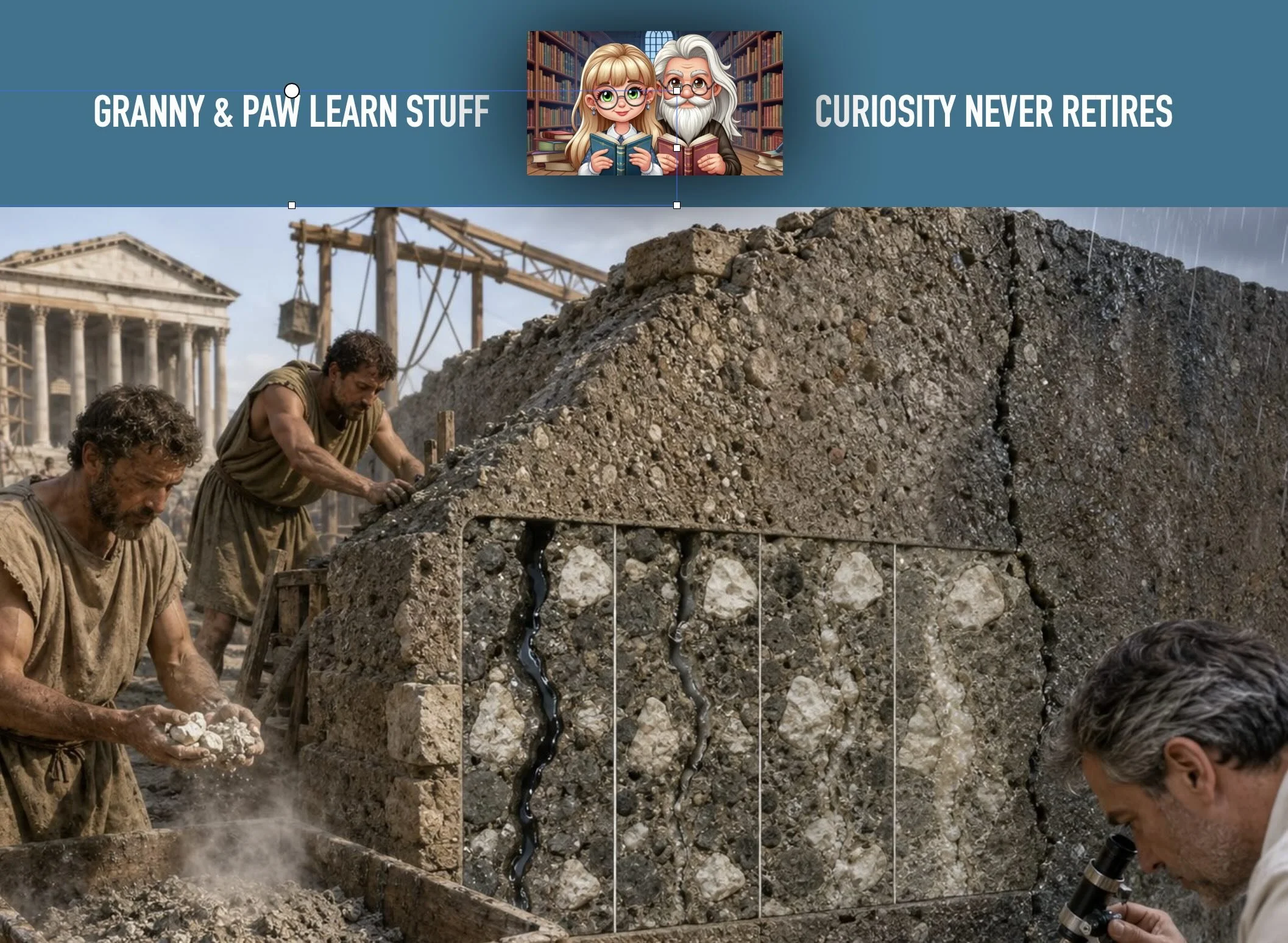
ANCIENT CONCRETE THAT HEAL ITS OWN CRACKS
What Happened:
For generations, the little white chunks found throughout ancient Roman concrete were often dismissed as evidence of careless mixing. Recent research suggests that, in at least some Roman concrete, those lumps—called lime clasts—were a feature rather than a flaw. Roman builders mixed quicklime with volcanic ash before adding water. This “hot-mixing” process left reactive bits of lime inside the hardened material. When a small crack later formed and rainwater entered it, the lime could dissolve, travel into the crack, and recrystallize as calcium carbonate—essentially growing new stone to seal the opening.
In 2025, researchers found compelling physical evidence at a Pompeii construction site abandoned mid-project when Mount Vesuvius erupted in 79 CE. Unfinished walls, tools, and piles of dry ingredients were preserved together, allowing scientists to reconstruct how the builders actually worked.
Why It Matters:
Concrete is indispensable but environmentally costly to manufacture. Buildings and bridges that repair small cracks and last longer would require fewer replacements and less material. In this case, a nearly 2,000-year-old technique could help inspire more sustainable infrastructure for the future. One caution: not every Roman structure used the same recipe, and this mechanism does not make concrete indestructible. But it beautifully overturns an assumption: what looked like sloppy workmanship may have helped the material survive for centuries. We think that is amazing!— Granny & Paw
Source:
2025 primary study in Nature Communications
Read the article here: plain-English explanation from MIT.
READ THE 2026 NOTEBOOK SO FAR


From the curious minds of Granny and Paw, we hope you've been inspired to embrace your own sense of wonder and never stop learning. Remember, the world is full of amazing discoveries, just waiting to be made. So keep asking questions, stay curious, and come on back and visit us any time on this enduring adventure of lifelong learning.
Yours in curiosity,
—Granny & Paw